
Why portable power is needed in healthcare and care now
In recent disasters and large-scale power outages, many cases have been reported where elderly care facilities and medical institutions lost power, causing major disruptions to care and medical treatment. In response, there is a growing movement to develop emergency power sources for social welfare and medical facilities. On the other hand, emergency generators involve heavy design, installation, and inspection costs, and many small-scale facilities and clinics hesitate to introduce them. As a result, attention is turning to portable power stations, which can be used immediately when needed and can be safely installed indoors.

Use cases in clinics
Although hospitals are proceeding with the installation of emergency generators based on laws and regulations, they do not necessarily cover all power sources. There are many situations where auxiliary power sources are desired, such as electronic health record terminals, medical refrigerators, and triage lighting.
Portable power is suited to uses such as the following.
- Continuing medical care on a reduced scale while maintaining some electronic health record terminals and reception systems
- Protecting temperature-controlled medications as a backup power source for refrigerated pharmaceutical storage
- Securing lighting, Wi-Fi, and communication means in triage areas and temporary waiting spaces
Not only at disaster base hospitals, but also at local clinics and doctor's offices, having portable power sources enhances the continuity of local healthcare and improves the reliability of disaster prevention plans.
* Varies by facility size and whether there is an inpatient ward.
Use cases in care facilities
In nursing care facilities, determining "which minimum equipment to operate" during power outages or disasters is crucial. In fact, an increasing number of nursing care facilities are introducing portable power stations as backups for medical billing computers, monitoring devices, lighting, and other equipment.
Expected usage scenes are as follows.
- Backup for high-priority medical devices such as suction pumps and oxygen concentrators
- Power supply for nurse call master units, monitoring sensors, and Wi-Fi routers necessary to ensure resident safety
- Lighting and smartphone power for night evacuation
A portable power station can supply electricity to such devices for several hours to about half a day, functioning as a bridge until recovery or full-scale evacuation.
3 benefits unique to portable power
Even in a power outage, move only what you need at once
A portable power station is a storage battery that can supply electricity simply by plugging it into a device outlet. Even though it is difficult to power an entire facility, electricity can be concentratedly routed to "life-saving points."
Rather than trying to "protect everything," the great value of a portable power station lies in its ability to prioritize running "devices that protect individual lives."
Protect users from heat and cold in disasters
For the elderly, heatstroke in the summer and hypothermia in the winter are life-threatening. Situations where air conditioners, coolers, and heaters cannot be used at all during a power outage must be avoided. A large-capacity portable power station,
- Compact circulator for air conditioners
- Electric blankets and small heaters
can be operated in specific areas such as "evacuation rooms" and "rooms for high-need residents." This significantly reduces the risks of heatstroke, dehydration, and worsening physical conditions.
Helps with BCP planning
Since April 2024, nursing care facilities have been required to formulate business continuity plans, commonly known as BCPs. For many facilities, the challenge is determining to what extent services can be continued during a power outage.
Portable power stations allow you to write specific numbers and procedures into your BCP, such as "how many units to introduce to run which devices on which floor for how many hours" and "how to operate them in evacuation and disaster prevention drills."
Uses safer lithium iron phosphate batteries
Featuring high safety where cells will not catch fire even in the unlikely event of damage, and high reliability trusted by automotive manufacturers worldwide, the adoption of lithium iron phosphate batteries achieves a long lifespan exceeding 3,500 cycles (with 70% or more capacity remaining)*.
*According to specifications, a typical lithium iron phosphate battery cell retains about 80% performance after 2,000 charge cycles, and about 70% after 3,000 to 4,000 cycles.
ASAGAO LiFePO4 battery vs. other brands NCM battery comparison video
Points to check before installation
Decide the equipment and time needed
- Which users, which devices, and for how many hours
- Which floors and rooms to make priority areas
By organizing the situation, the required output and capacity become clear, allowing you to proceed to specific considerations such as "what capacity of portable power station and how many units should be introduced."
Equipping nursing care facilities and clinics with portable power stations not only protects the lives of users and patients, but also builds trust, reassuring people that they can rely on this facility. As preparation for disasters and for everyday peace of mind, why not consider introducing the optimal portable power station for your facility when reviewing your BCP or conducting disaster preparedness drills?
3 types to match capacity and output to the use
Extra-large capacity model
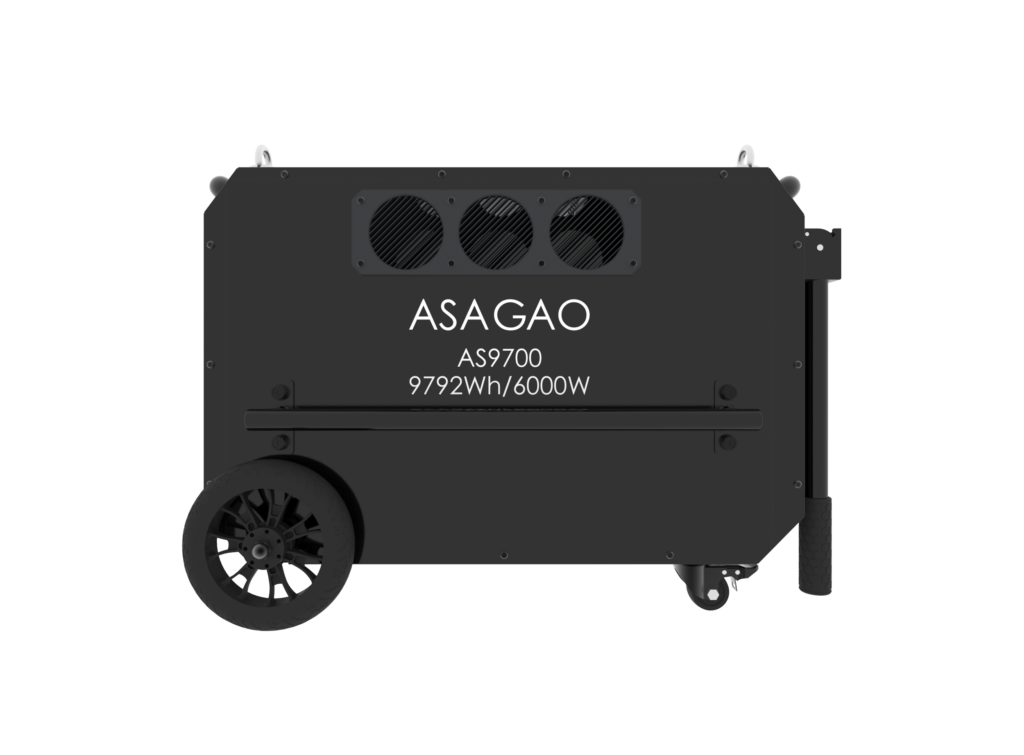
| Model no. | AS9700 | Unit weight | Approx. 130 kg |
|---|---|---|---|
| Size (mm) | W815 x D591 x H508 | Battery type | Lithium iron phosphate |
| Storage capacity | 9,792Wh | Charge cycles | 80% or more retained after 6,000 cycles |
| Max. capacity when expanded | 29,376Wh (up to 2 extra units can be added) | Operating temperature | -10 to 45 C |
| Operating temperature range | 0-45 C | Warranty period | 3 years |
AC output (6 ports total)
| AC output 100 V single-phase (4 ports) | 100V, 20A, rated 2000W x 4 ports (total output of upper and lower ports within 3000W). Surge maximum 6000W / supports 50/60Hz. 100V and 110V settings available. Total output up to 6000W possible across 4 ports |
|---|---|
| AC output 200 V single-phase (2 ports) | 200V, 30A, rated at 6000W per port (capable of outputting up to a total of 6000W across 2 ports). Peak maximum 12000W / supports 50Hz and 60Hz. 200V and 220V adjustable. |
| DC output | USB-C1 PD 100W ×1 / USB-C2 20W ×1 / USB-A Quick Charge 18W ×1 |
| Pass-through / auto-switch function | In the event of a power outage, switching is possible within 10ms. When 100V is input, only 100V output is supported / When 200V is input, only 200V output is supported |
Equipped with 200V 5000W ultra-fast charging, capable of a full charge in 2.5 hours
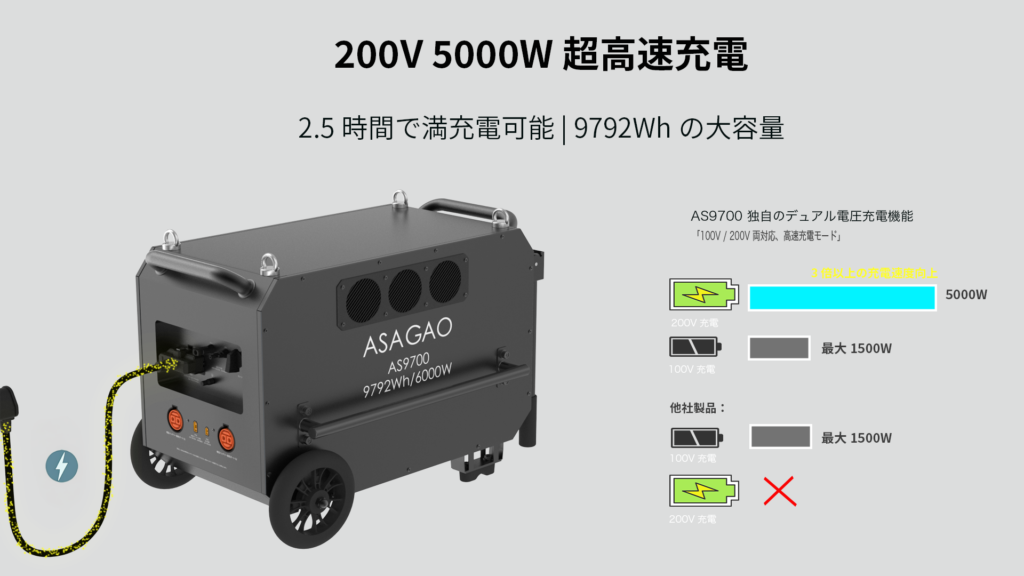
Also supports 3.7 kW solar charging
In addition to fast charging via AC outlet, it also supports a total of 3700W solar charging, allowing you to easily build an independent power environment using clean energy. Furthermore, it supports XT60 input (12V-30V, 10A), enabling charging from cars and other sources as well.
| AC charging (100V) | Max 1500W, 50–60Hz, 100V (approx. 7 hours to full charge) |
|---|---|
| AC charging (200V) | 5000W Max 50–60Hz 200V (approx. 2.5 hours to full charge) |
| PV high-voltage charge | 2500W Max 120–450V / 20A (Simultaneous charging with PV low voltage possible) |
| PV low-voltage charge | 1200W max 10–50V / 30A (simultaneous charging with PV high voltage possible) |
| XT60 charge | 11.5V–30V / 10A (XT60 charging and PV low-voltage charging cannot be used simultaneously) |
| Max. simultaneous charging power | PV high voltage + commercial power supply: MAX 5000W / PV high voltage + PV low voltage + commercial power supply: MAX 6200W |
Ultra-high output: Rated at 6000W, supports 100V/200V simultaneously
It features a high output of 6000W and supports 100V/200V AC output, making it compatible with a wide range of appliances—from power tools, commercial refrigerators, and high-output IH cookers to electronic devices like personal computers. Additionally, it supports 50/60Hz frequency switching via a dedicated app or manually*, allowing the use of frequency-fixed machine tools and other equipment.
Optional expansion batteryYou can expand the capacity by connecting them with a parallel cable. It supports up to 2 expansion batteries, allowing for a total expansion of up to 29,376Wh.
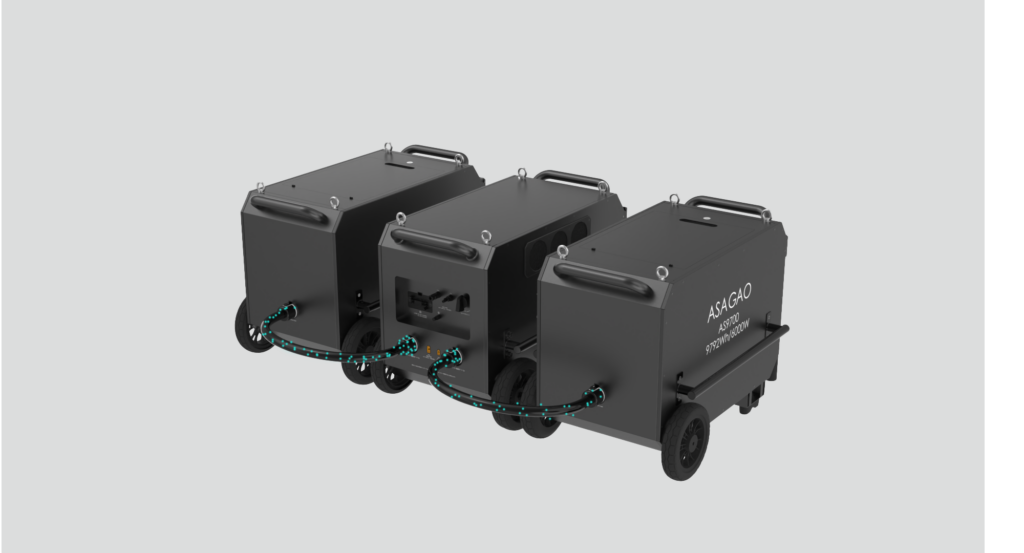
Capacity and runtime guide
| Capacity (connected electrical products) | Unit only 9,792 Wh | +1 extra unit 19,584 Wh | +2 extra units 29,376 Wh |
|---|---|---|---|
| Equivalent to 100W rated products (e.g. desktop PCs) | Approx. 100 hours | Approx. 200 hours | Approx. 300 hours |
| Equivalent to 50 W rated (LCD TV, etc.) | Approx. 60 hours | Approx. 120 hours | Approx. 180 hours |
| Equivalent to 300 W rated (refrigerator, etc.) | Approx. 28 hours | Approx. 56 hours | Approx. 83 hours |
| Equivalent to 700W rated products (e.g. air conditioners) | Approx. 12 hours | Approx. 24 hours | Approx. 36 hours |
| Products with a rated power equivalent to 1000W (such as hair dryers and electric kettles) | Approx. 8 hours | Approx. 17 hours | Approx. 25 hours |
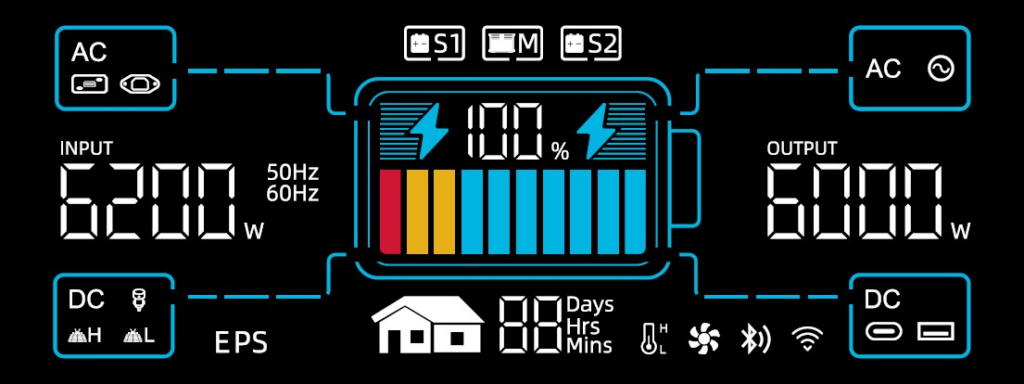
LCD panel that shows usage at a glance
You can check the device's status at a glance on the LCD panel, including remaining battery, available operating time, charging status, and the power status of each terminal. If a certain amount of time passes with all ports turned off, the power-saving mode activates automatically. The LCD panel brightness decreases, and after more time passes, the device automatically turns off.
Large / medium capacity models
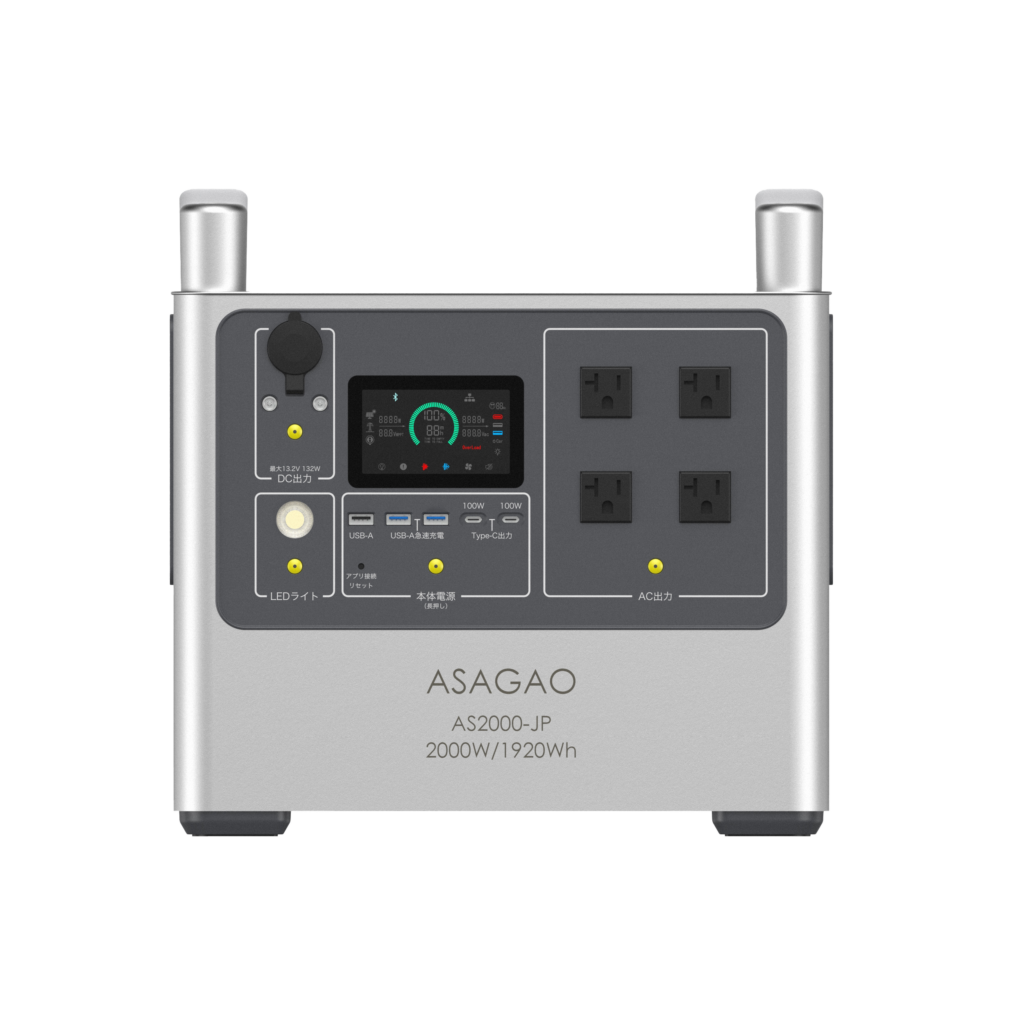
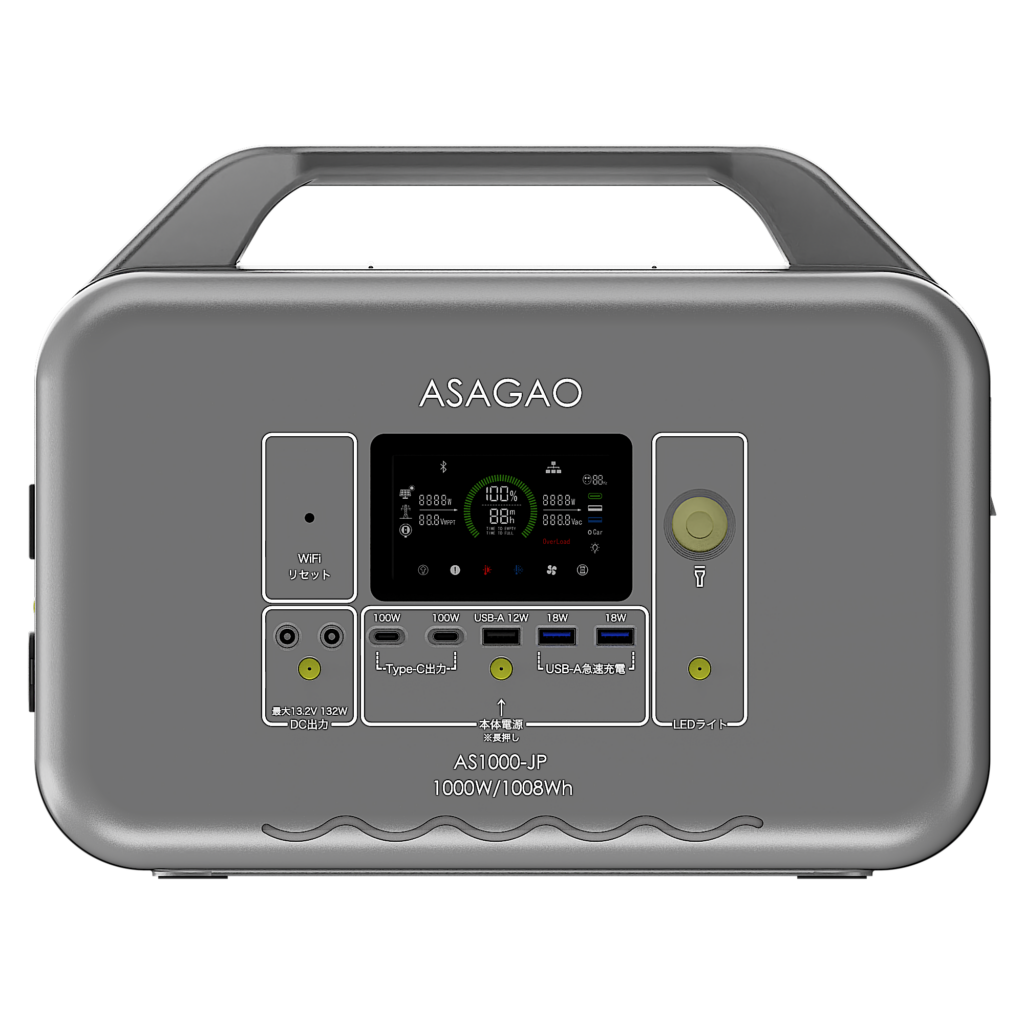
AS2000-JP intro video
AS1000-JP intro video
| Model no. | AS2000-JP | AS1000-JP |
|---|---|---|
| Size (mm) | L355 x W227 x H347 | L340 x W262 x H192 |
| Storage capacity | 1,920 Wh (48 V) | 1,008 Wh (22.4 V) |
| Charge cycles | After 2,000 cycles, 80% or more; after 3,500 cycles, 70% or more | |
| Unit weight | 20.5 kg | 11.7 kg |
| Battery type | Lithium iron phosphate | |
| AC output | 100V-120V × 4 ports, 50/60Hz / Rated 2,000W (Surge 5,000W) Pure Sine Wave / Overload & Short-Circuit Protection / αBOOST Mode: 2,800W MAX | 100V-120V × 2 ports, 50/60Hz / Rated 1,000W (Surge 3,000W) Pure Sine Wave / Equipped with overload and short-circuit protection functions / αBOOST mode: 1,800W MAX |
| USB output | 1 x USB-A port (12W) / 2 x USB-A fast-charging ports (QC3.0, 28W MAX) / 2 x USB-C fast-charging ports (5–20V/5.0A, 100W MAX) | |
| ACC output | 1 ACC (car accessory) socket (13.2V/10A, 132W MAX) | |
| Wireless output | Wireless charging port x1 (15 W) | |
| DC output | DC5525 (center positive) ports × 2 (13.2V/10A, 132W MAX) | |
| Operating temperature | -10 to 45 C (no condensation) | |
| Charging temperature range | 0-40 C (no condensation) | |
| Recommended charge for long-term storage | Store at 50%-70% (avoid high heat and humidity) | |
| Manufacturer warranty period | 5 years: 36 months from purchase plus an additional 24 months with member registration (Japanese language support provided within Japan) | 5 years: 24 months from purchase plus an additional 36 months with membership registration (Japanese-language support available within Japan) |
Estimated number of charges / usage time (for AS2000-JP)
| Machine | Power consumption | Guide |
|---|---|---|
| refrigerator | 300W | 8-16 hours |
| Microwave oven | 1,000W | 1.6-2.8 hours |
| Rice cooker | 170W | 5.8 hours or more |
| LCD TV | 120W | 8 hours or more |
| EV charging (16A) | 1,800W | 5-8 km |
| Drone | 60W | 25-36 times |
| Hair dryer | 1,400W | 1.2-6 hours |
| Notebook PC | 60W | 23 times or more |








Estimated number of charges / usage time (for AS1000-JP)
| Machine | Power consumption | Guide |
|---|---|---|
| refrigerator | 300W | 2-12 hours |
| Microwave oven | 1,000W | 0.5-1 hour |
| Rice cooker | 150W | 4 hours or more |
| LCD TV | 120W | 6 hours or more |
| Electric kettle | 1,000W | 0.5-1 hour |
| Drone | 60W | 12-15 times |
| Hair dryer | 1,400W | 0.5-4 hours |
| Notebook PC | 60W | 12-15 times |
ASAGAO refrigerator mode
Some electrical appliances, such as refrigerators, enter a dormant state (consuming 5W or less of power) once the internal temperature reaches a set value or under certain conditions. When the output power is low, some standard portable power stations switch to energy-saving mode and automatically turn off after a certain period of time. To prevent this phenomenon, ASAGAO products allow you to set the power-maintenance time for AC outputs of 5W or less from "Always ON" to 30-minute and 1-hour increments using the dedicated app, so you can safely use electrical appliances that switch to a dormant state. For intuitive understanding, the refrigerator mode is displayed on the app as "Standby time when AC output is 5 watts or less."
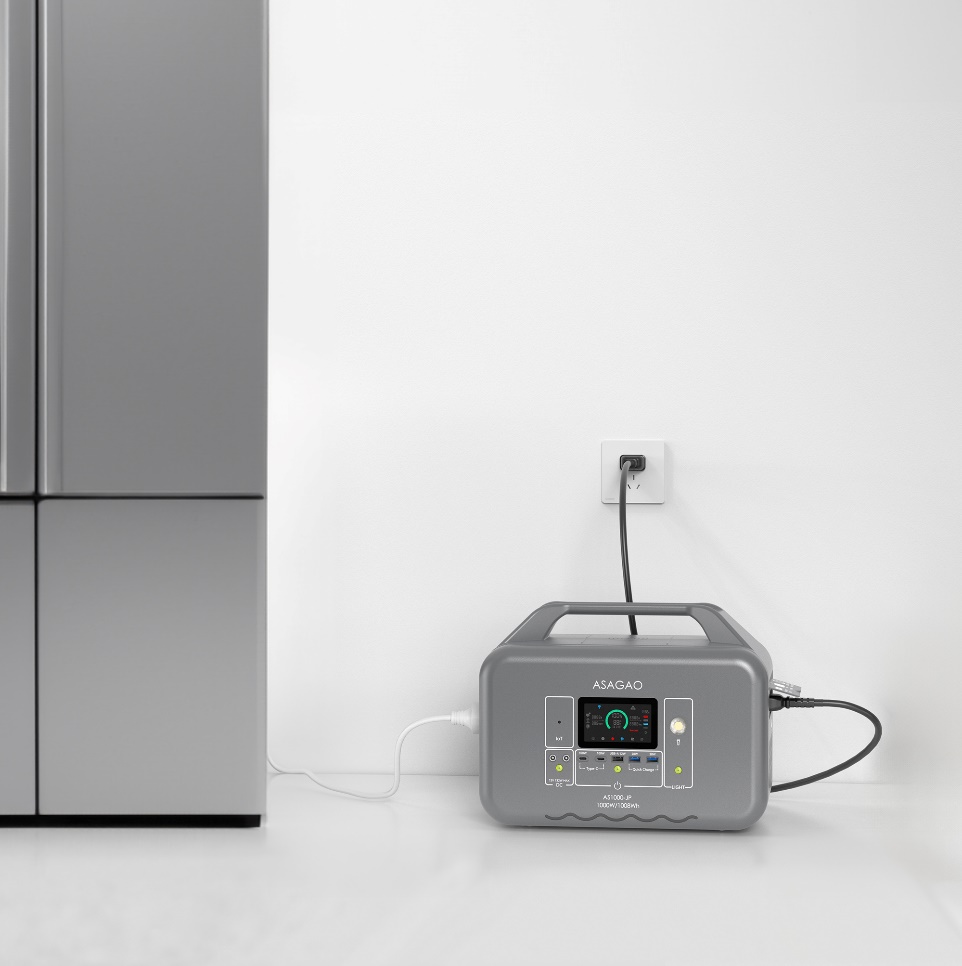
Refrigerator mode explained
About ASAGAO pass-through and auto switching
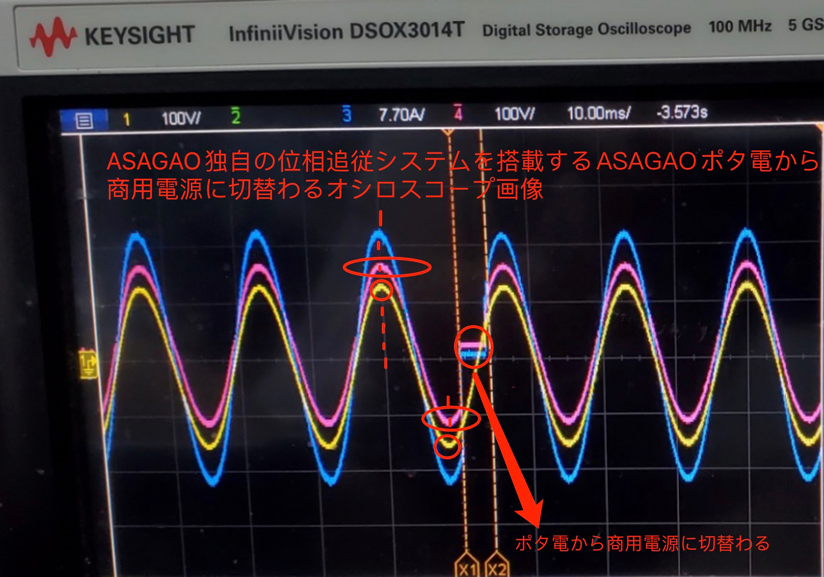
Proprietary phase-tracking system
As a BCP measure, portable power stations are widely used by connecting them between the commercial power grid and electrical appliances. In the event of a sudden power outage, the system switches from the commercial power supply to the portable power station, enabling a continuous power supply to the appliances. In this case, the portable power station serves the following two functions:
A: During power outage
It switches from the commercial power supply to the portable power station output. If the switching speed is slow, the electrical appliances connected to the portable power station will turn off, so at this time, the switching speed is of the utmost importance. ASAGAO products offer the fastest switching speeds in the industry. The actually measured switching speed of the AS1000-JP is 4 ms (0.004 seconds), and that of the AS2000-JP is 5.4 ms (0.0054 seconds).
B: On power restore
It switches from the portable power supply to the commercial power output. In this case, ASAGAO products have the fastest switching speed at 3ms (0.003 seconds), but even more important than the switching speed is that ASAGAO products match the voltage and phase of the commercial power supply before switching.
At Japan Medix, we provide end-to-end support for the introduction of portable power stations, from hearing your requirements and selecting the right product to the final installation. Please feel free to contact us.
Related videos
-
AS1000-JP MOVIE JP
-
AS2000-JP movie
-
ASAGAO Lithium Iron Phosphate Battery and Other Brands Ternary Battery Comparison Video 2022-09-09 17.26.58
-
Refrigerator mode explained