
Switching from incandescent bulbs to latest LED
Why to replace incandescent bulbs with latest LED
An incandescent lamp works by passing electricity through a metal called "tungsten," which is extremely resistant to heat, and heating it up to emit light.
An incandescent lamp works by passing electricity through a metal called "tungsten," which is extremely resistant to heat, and heating it up to emit light.
For example, in the case of an incandescent bulb such as "LW100V54W" (power consumption 54W, voltage 100V), the estimated lifespan is about 1,000 to 2,000 hours, which means it will reach the end of its life in about six months to a year if used for 6 hours a day.
Regarding the reduction in power consumption when replacing incandescent light bulbs with LED lighting
e.g.) Incandescent 54W vs LED bulb 7W
(54W / 7W) / 54W x 100 = 87
Power consumption can be cut by about 87%.
How much money can you save by switching from incandescent bulbs to LED lighting? (Estimated electricity bill savings)
If used for 5 hours a day for 1 year (365 days), the electricity costs for incandescent bulbs and LEDs can be estimated as follows.
| Bulb type | Annual electricity cost | Estimated cost savings |
|---|---|---|
| Incandescent bulb (54W) | approx. 3,055 yen | ||
| LED bulb (7W) | Approx. 396 yen | Save about 2,659 yen a year! |
* Electricity unit price used: 31 yen/kWh
If incandescent downlights or spotlights are replaced with LED lighting, electricity costs can be reduced to about one-tenth, making even replacing a single bulb a very budget-friendly choice for expenses.
Replacing lighting used for over 10 years with LED lights increases the risk of serious accidents due to aging and deterioration.
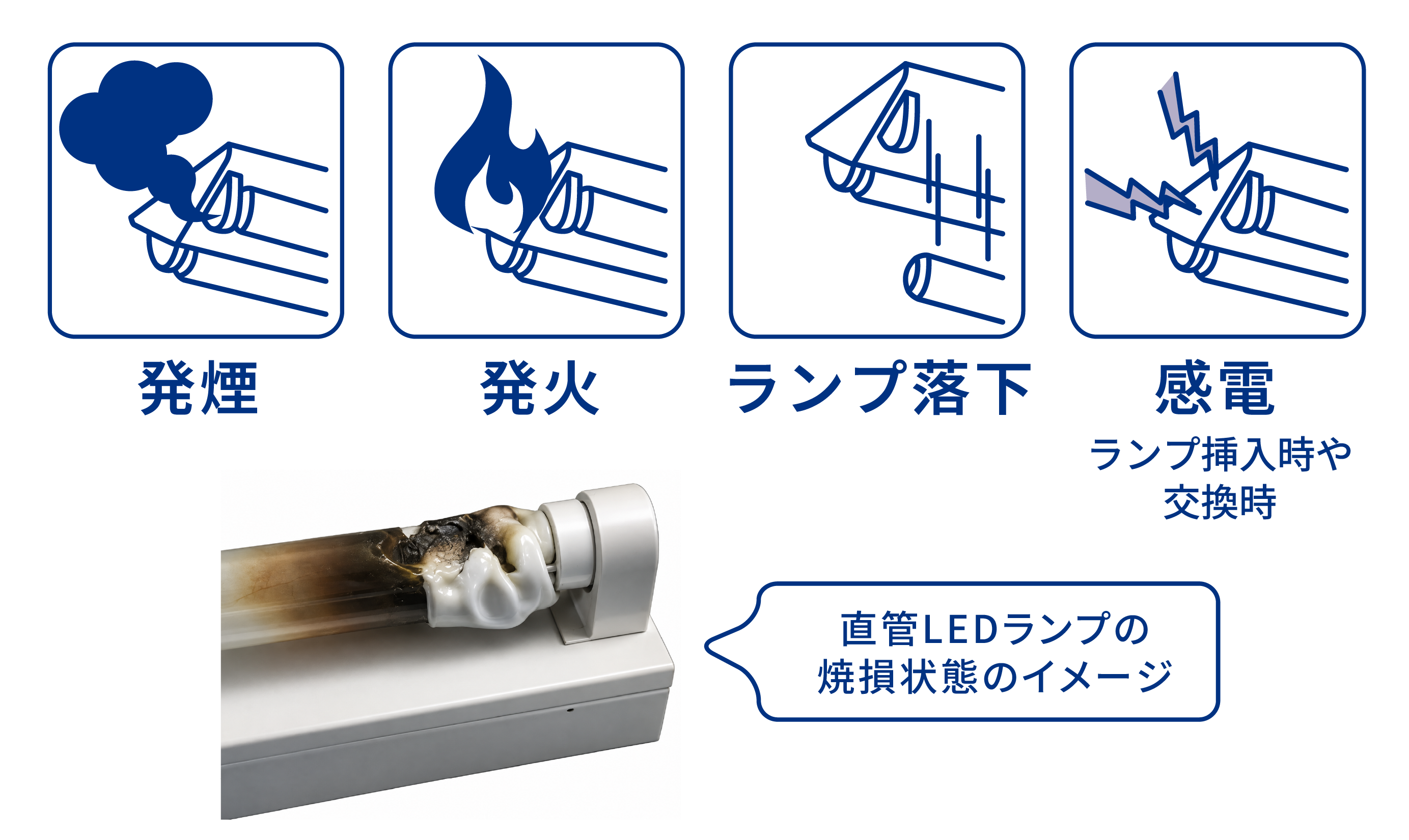
*This video is an experiment conducted by the National Institute of Technology and Evaluation (nite).
Because LED lamps differ in structure and electrical characteristics from traditional incandescent and fluorescent lamps, compatibility with lighting fixtures is extremely important. Incorrectly using incompatible lamps poses a risk of causing serious accidents such as smoke emission and fires. Furthermore, lighting fixture manufacturers' product warranties are premised on the use of specified lamps, so replacing them with incompatible LED lamps will void the warranty itself. It is a misconception to think that simply replacing the lamp allows you to continue using the lighting fixture as-is for a long time; when making a replacement, it is extremely important to thoroughly check the specifications of the fixture and the precautions indicated by the manufacturer in advance.
Please check the "Precautions When Replacing with LED Lamps" by the Japan Lighting Manufacturers Association below.
Accidents caused by improper installation have been confirmed when replacing fluorescent lamps with LED lamps while keeping the existing lighting fixtures.
* The video is an experiment conducted by the National Institute of Technology and Evaluation (NITE).
Benefits of switching incandescent bulbs to latest LED
Especially in facilities with high ceilings, it is necessary to prepare ladders or scaffolding just to replace light bulbs. By switching to LEDs, such troublesome replacement work at high places becomes almost unnecessary, saving you the trouble of maintenance.
Outstandingly long service life
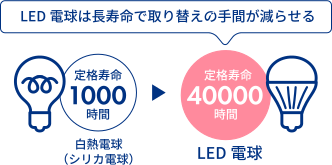
While the lifespan of an incandescent bulb is about 1,000 hours, the rated lifespan of an LED bulb is approximately 40,000 hours, boasting an overwhelming longevity of about 40 times that of an incandescent bulb. Assuming an LED bulb is used for 10 hours a day, this calculates to about 10 years of use. This long lifespan not only reduces the cost of repurchasing bulbs, but also creates the major benefit of significantly reducing the effort and cost involved in replacement work.
Especially in facilities with high ceilings, it is necessary to prepare ladders or scaffolding just to replace light bulbs. By switching to LEDs, such troublesome replacement work at high places becomes almost unnecessary, saving you the trouble of maintenance.
CO2 cuts that help the global environment
Reducing the power consumption of light bulbs helps decrease the fuel consumed in thermal power generation and the like, which directly leads to a reduction in carbon dioxide (CO₂) emissions generated during power generation.
Currently, efforts to curb such carbon dioxide emissions are accelerating significantly across society against the backdrop of international and legal movements, such as the promotion of SDGs (Sustainable Development Goals), revisions to the Energy Conservation Act, and measures to prevent global warming. Making familiar light bulbs more energy-efficient goes beyond mere cost reduction and has become an important action to protect the global environment.
Switching from incandescent bulbs to latest LED
At Japan Medix, we provide end-to-end support for LED lighting installation, from listening to your requirements to product selection and construction. With comprehensive after-sales support, including a long-term warranty of up to 5 years*, you can adopt our solutions with peace of mind.
If you are considering LED lighting, such as wanting to save on electricity soon or choose lighting that suits your facility, please feel free to contact us.
* Warranty terms vary by product.