
SSP combination therapy device Asteo installation report
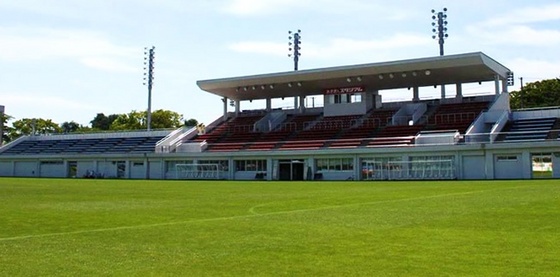
Introducing Blaublitz Akita
In 1965, the TDK Soccer Club was founded. It joined the Tohoku Soccer League in 1982 and finally achieved promotion to the JFL in 2006. In 2010, the TDK Soccer Club transitioned into the club team "Blaublitz Akita" with the goal of creating northern Tohoku's first J. League team.
It became a J.League Associate Club in 2013, entered the J3 League in 2014, and continues to the present day.
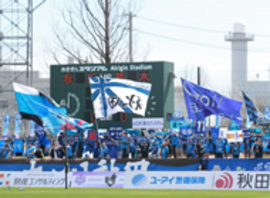
Japan Medix is a homepage sponsor of Blaublitz Akita.
We asked athletic trainers Kyota Ishizawa and Taisuke Hama about how they decided to become athletic trainers.
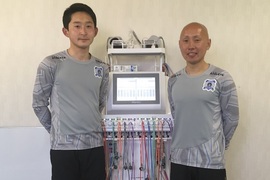
Trainer Kyota Ishizawa
I played soccer during my student days, but I had many injuries and was at a level far removed from professional players. My motivation started when I thought that by acquiring knowledge as an athletic trainer, I could create an environment where even weak players could receive proper care when injured. My inspiration for aiming to be a J. League trainer came when, while attending a training school, I had the good fortune to meet a senior who was active in the J. League, and through following in their footsteps, I developed a strong admiration and interest in the J. League.
Trainer Taisuke Hama
I was involved in track and field for six years throughout junior high and high school. There were times when I couldn't get the results I wanted, and times when my personal records plateaued. There were also periods when I was injured and unable to practice for a long time. I still haven't forgotten the joy of being encouraged by the therapist at the clinic who took care of me back then, continuing my treatment, making a comeback, and breaking my personal records. When I decided to quit competing and started thinking about getting a job, I talked to that same therapist, which made me feel the appeal and fulfillment of the athletic trainer profession. This led me to aspire to become a trainer so that I could be the one supporting athletes next. Although I am still inexperienced, I want to work hard to prevent injuries in the athletes I work with and help them perform at their highest potential.
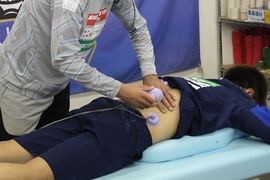
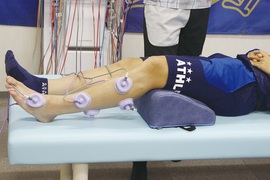
Q: For what main purposes is the SSP combination therapy device Asteo used on athletes?
A: Mainly for acute injuries, we use MC and HV, and we often use MF to relieve muscle tension caused by training.
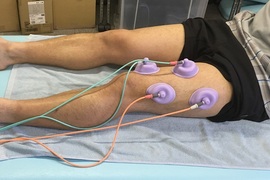
Q: How did athletes who used it rate it?
A: Due to the regional characteristics, there is a lot of long-distance travel, and we often hear people say that the physical fatigue associated with it is reduced by using Asteo.
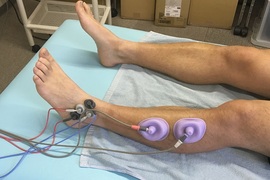
Q: Which mode are you using on Astreo?
A: Since it is often used after practice, using MF to relieve muscle tension is by far the most frequent application. Previously, we checked for changes by performing hamstring stretches before and after using MF, and both the players and the trainer were able to experience together that muscle tension was relieved and range of motion increased after use.
Q: Please tell us your impressions after introducing ASTEO.
A: Since introducing Asteo, I have realized that the range of approaches we can take for injury treatment, prevention, and conditioning has expanded dramatically.
Thank you very much. We look forward to your continued success.