"We decided that we should provide a service that would maintain and improve the situation where users could continue to live at home, and we came up with the idea of creating a new type of day-care service."
Mr. Kamada Kei GM of the "Light Garden" complex-type elderly care facility kindly spoke about the circumstances surrounding the reopening.
"There is a culture of "o-ryokan" hospitality in Shikoku, and people are accustomed to doing things for others. Often, elderly care facilities have a "o-ryokan" model, but this does not help maintain or improve the condition of the residents. Instead, we help the residents in whatever we can, and we help with the things we can't. The staff will decide whether or not we can do something, and we will assess whether or not we can do it. The original facility was "o-ryokan," so I think the confusion was very great for both the residents and the staff."
In August 2014, "Light Garden" reopened with renovations that included inheriting the Tsuchiguchi Daycare Center.
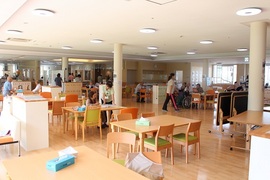
At "The Garden of Light," meals are also self-service. The facility being expanded has inevitably increased the distance that users have to travel, and at the beginning of the relocation, the users were uniformly exhausted by the time they returned home. There have even been complaints from their families.
Kamada GM looks back on those days. However, gradually, he no longer heard the voices from the users saying, "It's tiring."
“By getting used to moving around, their muscle strength naturally improved. While the risk of falling increases with longer walking distances, they hardly fall. Walking reduces the risk of muscle strength development. At “The Garden of Light,” we reduce the risk of falling by having them walk. However, we have arranged things in the route so that they can catch something if they do fall. Moreover, we have also prepared for the possibility of falling, and we have placed things that can catch them if they happen to fall. It is a training based on living at home and walking with your back to a wall.”
To support users' independence
“While working in various workplaces related to elderly welfare, I came to think about my own retirement from a perspective of wanting to live my life the way I want to. I came to the conclusion that I want to live freely at home without burdening my family. To live freely at home without burdening my family, I have to do as much as I can on my own. To achieve this, I am working in a way that allows the users to do things themselves.”
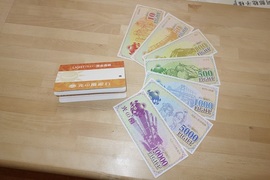
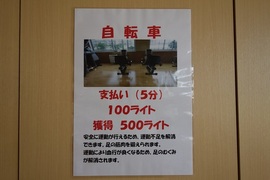
At "The Garden of Light," meals are served in a buffet style, and preparation is done by the users themselves. They reportedly take great care to keep the distance between the dining area, restrooms, and the bathroom as long as possible, and have also made an effort to encourage natural walking over long distances. Furthermore, the programs are designed to allow users to choose freely, and the facility uses in-house currency to pay for participation in the programs.
"The users pay a virtual currency to participate in the program, and by participating they can earn more virtual currency. To save the money they earn, we also provide deposit books. This not only boosts their motivation to participate in the program, but it also serves as a training in managing their own money."
In-facility currency and passbook featuring Tokushima specialties.It is a system where you can earn currency beyond the amount paid when paying for meals or participating in programs.
It is very important for users to be able to walk on their own at home. Especially at night, it is no exaggeration to say that the decision on whether or not family members need to provide care depends on whether they are able to walk to the bathroom on their own. For families, it is crucial that they not lose this ability. While this is not limited to walking, we believe that it is important to not simply provide assistance when it is easy, but to maintain the abilities that users have and improve them.
True support for users, in the true sense of watching over what can be done, supporting what is possible, and supporting what cannot be done, is what leads to the realization of independent and free living.
Staff who grow with users
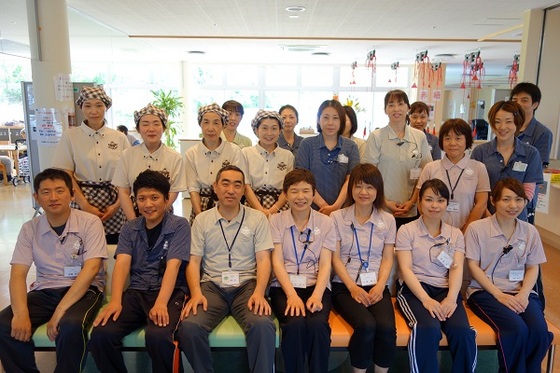
GM Kamata and all staff.
“We have a total of more than 50 staff members, but the age range is wide, from the twenties to the sixties. From the perspective of the users, they might seem like children or grandchildren. When the new facility opened and the staff increased, there were also times when we worked together with the users, learning by trial and error. It feels like we are growing together with the users.”
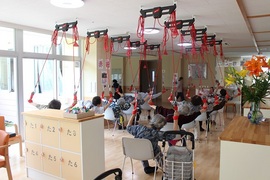
This is a demonstration of a program using the Red Code. On the day of the interview, many users were still working hard.The facility is spacious. Staff are using walkie-talkies to communicate information and share meeting content.
"Since it is important for the programs that users work on to produce solid results, we are assigning programs to staff who have completed training and passed the tests."
It seems that programs that utilize the Red Code are particularly popular with users.
Devices the on-site staff agreed on
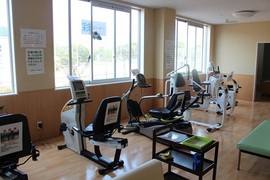
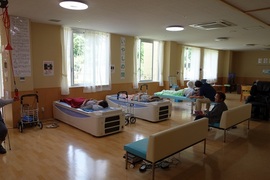
These are the most commonly used exercise therapy devices. Each of them has nicknames that evoke a sense of familiarity, such as "Bata-ko" and "Air Walk," and are helping users improve their muscle strength.We have installed two water pressure massage beds, the Aquaragon. It seems that they are very popular among the users who wait to use them.
Regarding the introduction of equipment, we decided based on the opinion of the physical therapists. It makes no sense for someone who doesn’t know the field to choose based on a catalog, let alone for a manufacturer’s sales representative to introduce the equipment they want to sell. Without equipment that the staff on the field is satisfied with, it will eventually end up not being operational after implementation.
The introduction of numerous exercise therapy devices allows them to efficiently support their exercise programs.
Sharing the Hikari-no-Sono style
Many care managers and medical professionals who are considering opening their own facilities come to visit "Light of the Garden." I would like to incorporate the good aspects of "Light of the Garden" into our facility, and if necessary, I would like to help out. With many facilities being "host-style," this is a unique situation at the moment, but I believe that in the future our style will become the standard, and I hope that it can be expanded. There are also many users who have improved their condition, so I would like to spread that word.
GM Kamada believes that they want to share the best aspects of "Light Garden" and to bring improvements to more people beyond the facility. They also reportedly are making announcements about improving the functionality of the users.
"I think there are still many things we can do to support our users. From physical to mental issues, I believe that users have many different concerns, and we must have the skills to support them. I hope to continue working with our users to address the challenges that arise as we go forward."
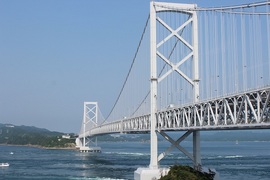
Ohnaruto Bridge, known for whirlpools
Tokushima City is a political, economic, and cultural center in eastern Tokushima Prefecture. It flourished as a castle town of the Tokushima Domain and has a deep connection with the Kinki region since ancient times. Human, material, and economic exchanges are still abundant today. The climate is warm, the local produce is abundant, and the greenery of Mt. Mimiyama, with its beautiful brow mountain, provides peace and comfort to those who live there, and the visitors are healed by it. Tokushima has distinctive culture nurtured by the local environment and history, such as the puppet theater, blue dyeing and Awa Shibira, and woodcraft products. Especially the Awa Odori held during the Awa Festival every August boasts a history of about 400 years and attracts about 1.3 million tourists from Japan and abroad during the four days of the festival. Currently, it serves as a junction point for the Kobe-Naruto route and the Shikoku Transverse and Crossroad Routes, working to cultivate modern industry and build a city that can cope with the era of high-speed informationization.