
Medical fitness installation cases
About installation
At Nihon Medix, we listen to the various concerns of businesses planning to open new medical fitness facilities—such as how to introduce and arrange a minimum set of exercise training machines within limited space, or whether the facility can be successfully operated in their local community—and provide optimal proposals tailored to their needs.
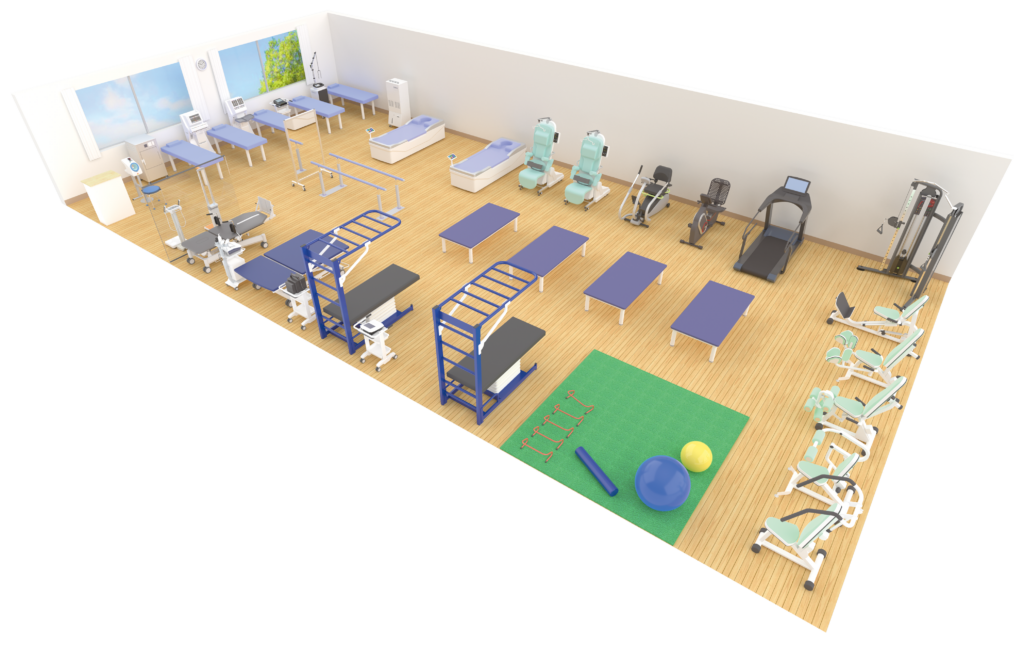
Medical fitness layout samples
This is an introduction to layout samples by space, created based on advice from a health and exercise supervisor.
Lifestyle-disease prevention training points
Why aerobic training machines are needed
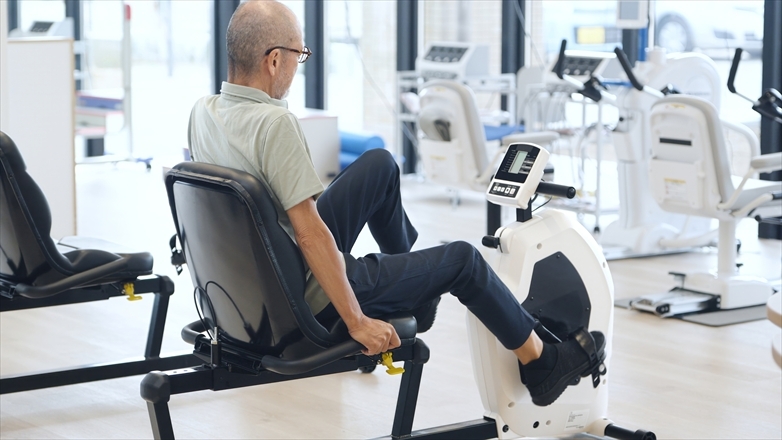
In lifestyle-related disease prevention training, aerobic exercise is essential. As a machine that obese people and those unaccustomed to exercise can start with at the beginning of their training,Cycle ergometerallows relatively easy training.
A type that pedals in the same wayRecumbent ergometerは、 Cycle ergometerThis machine places even less strain on the body. Because it features a backrest, you can pedal without having to support your own body weight or maintain core stability, making it suitable for those with low physical strength or the frail.
Also, the most ideal aerobic training is walking using the whole body. For this, treadmill training is ideal. However, since it can be tough for those who are not used to exercising,Recumbent ergometerorCycle ergometerStart from there, and as you get used to it, gradually increase the load.
UltimatelyTreadmillSo, we will set them up so that we can train with inclines. Since they are used frequently, we would like to place as many units as possible, but we will adjust the number of units depending on the space available.
Sample medical fitness introduction program
Here is an introduction to effective exercise program examples and compatible equipment and devices for the prevention of lifestyle-related diseases.
When introducing medical fitness
Japan Medix recommends well-rounded exercise.
The well-rounded exercise concept posits that skillfully combining not only aerobic training, but also strength (resistance) training, stretching, and balance training yields higher exercise benefits than performing just a single type of training. Since the 1990s, organizations such as the American College of Sports Medicine (ACSM), the American Heart Association (AHA), and the National Institute on Aging (NIA) in the United States have recommended comprehensive exercise programs rather than just aerobic ones.
Naturally, different types of training have different effects on the body.
For example, aerobic training does not provide a significant increase in muscle strength. Also, while strength training does not have a direct effect on resting heart rate, aerobic training can reduce it.
By performing exercises with different effects, the practitioner's level of health is further improved. Additionally, by combining multiple exercises that yield the same effect, the benefits of the workout can be enhanced even further.
Sample programs
Measurement and evaluation
By conducting measurement and evaluation first, it is possible to assess an individual's physical abilities and create a customized exercise program for safe and effective training.
Stretching
Stretching the muscles sufficiently and widening the range of motion of the joints helps prevent injuries. In addition, incorporating it as a warm-up before training raises the temperature of the muscles and body, resulting in efficient exercise effects.
Aerobic exercise training
Walking is the simplest and most accessible aerobic exercise, but many obese individuals and middle-aged or older adults suffer from knee conditions. Please choose equipment that puts as little strain on the knees as possible.
It is effective if performed for 30 minutes or more, 3 or more days a week.
[For people with high blood pressure] Continue doing mild exercise at 50% of your maximum oxygen uptake for about 30 minutes every day.
For diabetes patients: perform at least 20 minutes a day, at least 3 times a week. The heart rate should be maintained at an exercise intensity of 40-60%.
[Exercise Intensity] Around 50% of your maximum heart rate.
Strength training (resistance)
Strength function improvement training is important for increasing basal metabolism. It is effective to start training from large muscles such as the thighs, back, and abdomen.
Balance training
Performing balance training can improve the coordination of the neuromuscular system.
By skillfully combining balance training into your exercise program, you can achieve higher exercise effects than by performing only aerobic exercise and muscle function improvement training.
Cool-down
Helps regulate breathing and ease muscle fatigue.
Measurement and evaluation
By measuring the effects of exercise, you can objectively evaluate the degree of improvement and use it to help create future exercise programs.
For inquiries regarding medical fitness implementation cases,
Japan Medix provides comprehensive support from clinic opening plans to equipment selection and layout. If you are considering opening a clinic, please feel free to contact us.